Thursday, 18 June 2009

Still earning its keep.


Here's a recent glimpse into a French shed. A wobbly and out of focus shot due to a half-starved Alsatian straining at its chain intent on grabbing what little virility I have left, I'm relying on more knowledgeable blogistas to identify the vehicle therein. From the little to be seen, it is utilised on a very occasional basis to gather the winter log supplies and has sacks thrown over it after its spells of duty. The registration number '89' gives its location as The Yonne and this is The Puisaye area. It looks to be American and I suppose was either abandoned there after the War or became one of the many French governmental vehicles which were drafted into the likes of Les Pompiers. This one's still in Olive Drab so maybe it was 'liberated' after all? The region of The Puisaye, whilst only about an hour and three quarters from Paris remains largely 'undiscovered', particularly by Brits although the Dutch have caught on in a bigger way. It is an area of blissfully beautiful countryside peppered with quiet villages and hamlets. If you are a night owl - forget it - everything closes down at around 7.00pm. On the bright side you can get a nice drop of Pastis 51 at 6.30am! Should the mood take you, they do a fine line in scythes and effective hand tools at the local agricultural merchant, all designed to help you tackle the wilderness you'll have to cut through to gain access to the 85,000 euro farmhouse, barn, seven hectares of woodland and a sizeable lake you've just purchased (having spent an expensive morning in the bar with the friendly local estate agent - see earlier reference to Pastis)

Friday, 5 June 2009

Ploughs and pasties


St Winnow, Cornwall near Fowey. Where else, at the end of a gorgeously remote lane would you find a roadside caravan dispensing exquisite food and providing a diversion in the form of a farming bygones and miscellany museum? The weather was kind as we sat and munched our way through homemade pasties, farm-reared pork and South Devon beef rolls of such ample proportions that we were fair tuckered by the end. The museum (or large shed as it should better be described) is educational in its diversity, covering such miscellany as wheelwrights tools, primus stoves, gas masks and what can only be described as a devotional to David Brown tractors. These red prime-movers are scattered throughout the place, poking out from under sacks, standing in dusty formation and in one unlikely pairing, hitched to an old fashioned threshing drum. I say 'unlikely' for the tractor concerned is one of those airfield jobs which used to tow bombs and aircraft around the bases of Britain - all nicely faired-in and streamlined,surely only to satisfy the designers eye, as no possible aero-dynamic advantage could be gained. The building in which this lot is housed has a familiar construct about it; telegraph poles with their id. numbers still attached and clad in that perennial favourite, corrugated iron. The smell is delicious and well known to those of us who enjoy visiting such places...oil, grease, paraffin, diesel fuel and grain, with a mixture of old sacking and hay. A short walk down to the river brings you to St Winnow Church where episodes of Poldark were filmed...which applies to most of Cornwall...but it is a fabulous building with a barrel vaulted roof and wonderful carved pew ends. The day for us was rounded off nicely with a few pints at the admirable New Inn at Tywardreath - no food, just 'salt and vinegar' or 'plain' - and a great bunch of regulars.

Friday, 15 May 2009

Thomas, titfers and tobacco


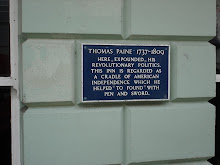
Lewes - although but a short distance from the questionable beauties of New Anzac is culturally, architecturally and socially on another planet. The beautiful county town of East Sussex has, since the founding of nearby Sussex University, become home to a sort of intellectual upper middle class. Despite this it has an underpinning of anarchy in the form of the famous bonfire celebrations and their associated societies and also a deep-rooted radicalism. Arguably Britain's greatest radical, Tom Paine was an exciseman here and debated his influential politics in the historic White Hart Inn - a plaque outside commemorates his influence and records the part he played in the establishment of American independence. 


Lewes abounds with pubs, the best of which are fed by the town's brewery and lynchpin, Harveys. It also has some interesting shops...avoid the usual 'one candle and a bolt of bleached linen' designer-homes variety of which the town has its share and instead head for Messrs Hugh Rae, Gentlemens Outfitters where you may purchase regimental or squadron blazer buttons to complete the caddish look. Why not buy a cravat? there's a range of paisley and military designs from which to choose. Or a very nice line in Tattersall check shirts. Trilby hats, Panamas, and Deer Stalkers are the favourites here along with those camel coats with velvet collars so beloved of the racing fraternity. Should clothing not be on your agenda, there's Catlin's just along the road  - a proper tobacconist selling the substance in all its infinite variety from cigars, to cigarettes, to loose pipe tobacco to snuff.  For all I know 'RedMan' chewing tobacco may be offered illicitly but I doubt it, the pavements give no evidence. Choose a pipe, or a cigarette holder, a tobacco pouch or a cigar cutter, indeed all the impedimenta of smoking, all the stuff that makes it so satisfying, and it's there just for you. However, if like me you are a lapsed smoker you cannot help but be seduced by the smells and packaging and remember the days. I no longer smoke but I still find the scent from a freshly opened jar of pipe tobacco absolutely heavenly. One glimpse of an old packet of 'Paffing Cloud', 'Gold Flake' (my favourite) or even 'Nelson' gets me coughing with excitement. She's a cruel mistress, tobacco, but to assuage your guilt you could pretend you were nipping into Catlin's for a bar of chocolate...

Thursday, 30 April 2009

On yer bike


They don't produce catalogues like this any more. A seductive drawing by Sydney R.Jones sets the scene for life in BSA land. No rain here, just a blustery day, and the countryside of England and Arthur Rackham woods within easy reach. The 1920's when a working man could buy (on easy terms) a motorcycle to liberate him and his family - should he attach a sidecar - to explore the open road. Cap reversed, a pair of Gamages shatterproof goggles a pair of stout boots and waders, and father was ready for whatever the elements could throw at him. A seaside trip to Dungeness or Camber Sands maybe, or a run over to Ashdown Forest for a picnic, the missus on the pillion (or 'tart tray' as it was unkindly known), accompanied by a couple of kids safely swathed in tartan rugs in 'the chair' - what fun! what an adventure! A stop for petroleum at the wayside garage where the kindly attendant, quite often a superannuated blacksmith, would hand crank the pump up and down its ratchet, delivering half a gallon a time of R.O.P. or 'the cheapest'. Top up with Castrol served in a thick glass bottle, maybe buy half an ounce of St.Julien and a packet of green papers and we're off again. The trusty BSA thumping away until the destination is finally reached. Buckets and spades are distributed and the kids charge over the Camber sand whilst father pricks the jet of his brass Primus stove and sets the kettle to boil for the ritual mug of tea. Mother, her Marcel Wave seemingly set in stone elegantly stretches out her legs as she reclines on fathers mackintosh. By lunchtime the kids are starving and the Shipham's paste sandwiches are dispensed from their greaseproof paper wrapping washed down with Fryco lemonade, the meal concluding with a giant Arrowroot biscuit. A post prandial nap for mother and father and a contemplative cigarette heralds an all-too-soon departure. The nights are drawing in and they've stolen a beautiful Autumn day. It's only wise to prepare for the final few miles home in the dark so dad tops up the carbide container on the acetylene lighting generator. This time he's remembered to bring a bottle of water from home but many's the time, 'in extremis' he's had to use his own, and a pretty precarious and difficult operation it's been. All aboard!, and one long swinging kick brings the BSA back to life, settling down to a steady rhythmic beat, push the hand change gear lever through the gate to first and we're homeward bound. Just another great day in Beeza - land.

Friday, 27 March 2009

Elephant Bug


The Bugatti family were certainly a talented bunch. Carlo, the patriach was a designer of extraordinary furniture and jewellery whilst sons Rembrandt and Ettore were sculptor and automobile designer/manufacturer respectively. The picture taken at the HQ of the Bugatti Trust at Prescott near Cheltenham shows the radiator of one of the world's largest and rarest cars, the Bugatti Royale. Truly a leviathan, the 12.7 litre cars of which only six were built were a bit of a white elephant for Bugatti and he found them difficult to sell, even to the super rich of the day. Powered by an exquisitely sculpted and engineered motor it had but three speeds in its rear-axle gearbox of which top was only really necessary. Despite the size it looks perfectly proportioned in the metal with wonderful detail touches such as hand scraped finishes to the engine castings and sublime (and enormous) cast aluminium wheels. This example is now owned by the current Bugatti manufacturers, Volkswagen and is maintained by English specialists. The nice touch of using an elephant as a radiator mascot was, I like to think a touching memorial to Ettore's brother Rembrandt whose work it is - poor Rembrandt took his own life in 1916 at the age of 31. Ettore Bugatti was quite an extraordinary man and ran his factory from a chateau at Molsheim where he could also indulge his love of fine horses and carriage driving. His automobiles, among them the beautiful Type35 racing car were known as 'Pur Sang' or 'pure blood' just like his nags. The adoption of the eliptical logo with a capital 'E' reversed and conjoined with a 'B' over the name Bugatti on a red ground is iconic, and to carry the equine theme through, most Bugatti radiators were horseshoe-shaped; simple, distinctive and beautifully made of German silver. If ever an automobile designer got it right, it was Bugatti. The smallest details like bolts manufactured with their own distinctive built-in washers, were his trademark. Ever resourceful and pragmatic, the manufacturing capability was there for The Royale, so he built more engines and created innovative railcars for the French government. These were in use up until the war setting speed records along the way and utilised four of the mighty Royale engines...what I would have given to have stood next to a fast stretch of line to hear one go by on its open exhausts. After the death of his beloved son Jean, Bugatti carried on with many projects, working on new designs throughout the second world war and indeed created the exact opposite of the Royale in the Type 72, a 12.6cc supercharged cyclemotor designed for use in post-war austerity France...like it's big brother it never caught on. No detail was too small to escape 'Le Patron's' eye from the hinges on the doors at Molsheim to the design of carriage harness, to his clothes. I give you Ettore Bugatti - a jolly clever man.

Thursday, 19 March 2009

Lido Land


This gem of a lido lies adjacent to the busy A259 South Coast Road at Saltdean near Brighton. Built in either 1935, '37 or '38, depending upon who you believe, it was designed by RWH Jones and owes a little to the De La Warre Pavilion some miles East. It's now designated a grade 2 listed building which unfortunately doesn't guarantee its future (but helps) and seems to fall in and out of favour with the local authorities. It was grandly overhauled in the '90s but is beginning to look a little neglected again and could do with a lick of paint. Jones also designed the Ocean Hotel further up the hill which must have seemed opulent indeed back in the '30s...it became Butlins Ocean Hotel in 1952 having served its country throughout the war as The Auxiliary Fire Service College. Billy Butlin paid a quarter of a million for its 350 rooms and it remained a hotel until 2005...it's now a halting development project. Back to the Lido - it's a confection of concrete, crittalls, curves and ship-like structures with a terrace and sun deck. It has a proper childrens pool next to the adults one and now sports a sort of sail that is unfurled in the unlikely event of anyone being in danger of burning by the sun - a bit like they used to do in ancient Rome at The Colloseum, except in Saltdean they don't need half the sailors in the Roman Navy to unfurl it. It's not such a leap of imagination to visualise lying out on the grass in woolen bathing trunks, with a plate of dressed crab and a Thermos of tea, News Chronicle at the ready to swat the flies, whilst watching the gay young things in their bathing caps disporting themselves in the icy waters. On fine summer days the place is as popular as ever and the ghosts vanish. Why, isn't that Henry Hall I can hear wafting out of the Tannoy speakers?

Monday, 16 February 2009

The human G-nome project


English front gardens 'peopled' with gnomes and ornaments are getting more scarce as gardens become parking places. Here's a choice example from our Cornish trip, which county incidentally, seems to sport some real exotica. This was in an urban location not far from the excellent art gallery and museum in Penlee House, Penzance. What a cornucopia of plaster people, animals and plaques, upon which are writ sincere thoughts of the 'arrive a stranger, leave a friend' variety. There's something about this wish to 'improve' upon nature that I find rather charming in a perverse sort of way. Are garden gnomes merely the natural external extension of plaster flying ducks across the sitting room wall or have they a more subtle meaning? That's the burning question of the day.