Wednesday, 5 November 2008

Crash, bang, wallop!


It being that most sacred day in Lewes, November 5th this is all I have to offer at the moment. This morning at 6.30am down in New Anzac on Sea I heard an explosion which heralds the days' doings in our county town some five miles distant. The bonfire boys have greeted another anniversary in their long tradition of celebrating the disemboweling of Guido Fawkes and the remembrance of the burning of protestant martyrs outside what is now the town hall. The town supports several bonfire societies whose members spend all year preparing for their day of days. Torches are made by the thousand and 'Lewes Rousers' (a particularly violent and powerful type of Rook scarer) are stuffed into bags ready for chucking around the feet of the crowds tonight. The atmosphere has been building for weeks - collecting tins shaken in the streets, collectors dressed in their costumes, programmes being sold. Giant papier maché effigies are made in conditions of high secrecy in order that the 'enemies of bonfire' are not revealed until the last moment. We've been treated to all sorts over the years from George Bush to General Galtieri, to Maggie Thatcher, to local politicians. They're always superbly crafted, irreverent, often crude in subject matter and stuffed full of fireworks and explosives... at the end of the evening having been dragged through the streets (these things are huge) they are ignited to huge applause and joysome noise. Bonfire concludes with Bonfire Prayers said around the war memorial on School Hill after which rites of passage, lunacy or substance abuse cause some persons to run through the glowing embers of the spent torches. They feel no pain - until tomorrow.

Sunday, 26 October 2008

The pound in your pocket


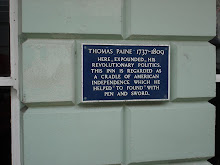
Introducing The Lewes Pound. Well it's been around for a while now and seems to be catching on in the town. As an idea to stimulate trade within the borough, it's caught on. You can buy your pounds at certain centres including the town hall and spend them in participating shops and pubs (and that seems to include most of the places you actually might want to shop or drink) - naturally Sid the supermarket supremo in any of his guises will have nothing to do with the scheme. If at any time you feel worried that you don't have 'real' money in your pocket you can exchange your Lewes note for a gold coloured clod. You can have them as change and thus increase circulation. The note itself is properly watermarked and has all the familiar swirls and flourishes so beloved of the engraver (sorry, Mac operator), it' s numbered too and the admirable Harveys brewery has a weekly draw based upon such numbers being in the lucky winners posession. A fine study of Lewes' most influential citizen, Tom Paine adorns the front and also an image of Lewes castle creeps into the local iconography. All this as you would expect from the town whose drinkers defeated, nay trounced, the mighty Greene King in a fight to have their local beer still served in one of Lewes' favourite pubs - The Lewes Arms.

Wednesday, 15 October 2008

How much longer?


This Victorian letterbox is set in the wall of the old vicarage in Telscombe, East Sussex. Allegedly inhabited by the drummer of a famous rock band, the building is in fine repair and the post is still collected faithfully from this long-serving receptacle. You can't help but wonder how much longer this will all last, what with village post offices closing wholesale and the inexorable rise of email (try sending a parcel, mind). The physical presence and survival of these cast iron symbols of another age is nothing short of miraculous and serves to remind us that there were complaints in late 19th century London that letters posted in the city were not delivered within four hours. My how times change. Still, I for one am pleased that there are so many survivors. Telscombe village by the way is 'on the road to nowhere' and is as pretty a spot as you could wish to find, sitting in a deep hollow of the South Downs just a few miles south of Lewes. The benevolent squire of the village, back in the 'noughties, 'teens and twenties of the last century was named Ambrose Gorham. A successful bookmaker, Gorham bequethed the village and farmland to Brighton Corporation and it belongs, administered by The Gorham Trust, to, I suppose, the City of Brighton and Hove to this day. There was never a pub which has kept the place quiet and largely free of visitors, but the Squire built a social club for the benefit of the villagers. This' turf accountant' owned a Grand national winner 'Shannon Lass' and photographs of various horse racing triumphs once adorned the walls of the club. There is a most attractive church (of St.Laurence) on a site where there has been one since 960 odd. It's well worth a detour as you motor between Lewes and Newhaven or are walking the South Downs Way...for the hardy, there's a Youth Hostel to rest your weary bones.

Monday, 13 October 2008

A Chateau full of surprises


If you trundle sedately South down from Dijon you will come upon the village of Savigny-Les-Beaune, and there you will find the Musee Du Chateau de Saigny-De-Beaune. A perfectly nice, traditional chateau with those pretty conical tops to the towers, it is in the heart of vineyard country and produces its own wines of that name and very fine they are too. In this rare instance though, my visit was not for purposes of alcoholic consumption but was rather that I was drawn by the sight of what must have been in excess of thirty jet fighter aircraft idling their time-expired lives away amongst the vines. Some had clearly been there a long time whilst others were relatively new arrivals - one thing was certain, they'd never take to the air again, leastways not from their present location. 'Worth a stop' I conjectured and my wife reluctantly, yet supportively, agreed. What we found was an Aladdin's cave of the most fascinating kind. Our journey took us through the wine shop and into a series of stables which housed a stunning collection of Abarth racing cars and equipment on two floors; here too was the reserve collection of unrestored and original motorcycles festering quietly in their own area awaiting either the restorers magic touch or....nothing. Outside and across into the main chateau found us climbing a vast staircase to the first floor where the premiere collectione' was displayed. From ceilings hung Victorian and Edwardian cycles, tricycles and light motor assisted bicycles - even a light aircraft. And then the row upon row of motorcycles down each side of the long narrow rooms; motorcycles of mainly French and British origin in good to mediocre condition, none apparently recently used all awaiting a turn of duty. The towers at either end of the corridors each contain a dais - on either end a collection of Vincents and Manx Nortons respectively. In the niches and fireplaces on the tower walls are shelves of engines of the most esoteric kinds, from Belgian FNs to French Motebcanes, twins, singles, 'V's and flats - everything one can imagine and all with that 'slightly unused, I want to be liberated' feel about them. I'm determined to go back, maybe to coincide with Europe's largest old 'bike event,  'Les Coupes de Motos Legendes' at Prenois near Dijon, next year...always supposing the end of world as we know it hasn't happened by then.

Wednesday, 1 October 2008

It couldn't be England


The view from our motel window just couldn't be England. Corn, yes, well we have it, elephantine eye-height too, but those yellow things in the background - we don't have them. Railroad freight cars of great height and length with a suitably low entry to best facilitate the ingress of hobos. We were in Connorsville at the very east of Indiana where once well known automobiles were made, amongst them Cord and Duesenberg. Now it's a fairly ordinary place which we were passing through on our way to Nashville, Brown County Indiana, as part of an extended road trip. Arriving late and in need of both liquid and solid refreshment we were recommended and directed to 'Mousies'. Literally the other side of the tracks, we found ourselves in a packed 'bar-with-food' establishment where, on this friday night locals of all class and colour came to wash away the week's sorrows or simply gather for what looked uncannily like PTA meetings. Smoking's still allowed and virtually everyone lit up after their dinner, which made for a rather surreal experience - how quickly we forget.The waitresses were reassuringly mature, (if anyone has been to a 'Hooters' you'll know what I mean) loud and extremely efficient. Several glasses of the chilled and ubiquitous Chardonnay later we paid the bill to much "where d'yall come fraaam-ing" and exhortations to ~"y'all come back neaow, we never done had no one fraam Eeengland here afore". We probably shan't ever again visit Connorsville, although it appears we missed both the preserved steam railroad and the canal. What we did find however was a genuine, almost naive wish to please and to bid us well, often from people who'd never ever have the opportunity to indulge themselves in such exotic pleasures as we. There's a lot to dislike about the USA (and the UK come to that) in terms of world politics at the moment, but the ordinary folk are decent and friendly with an open, sometimes childlike quality which is most endearing. 

Tuesday, 9 September 2008

Through the gate


A variation on 'over the hedge', 'through the gate' is pictured in rural France, not a million miles from St.Sauveur en Puisaye in The Yonne. Here there are still a goodly number of aging tractors doing sterling service. This little group comprising a Grey Fergie, Nuffield and a little International nestle behind the gate. There appears to be a plough of the 'towed' variety there too along with the obligatory but thoroughly modern wheelbarrow. All it needs to complete the scene is a blue-jacketed farm worker with a Gauloises drooping from the bottom lip. He will have come to work on his heavily abused Mobylette moped via the village cafĂ© where breakfast probably meant a strong black coffee and a small glass of chilled red wine. As a treat there might be a tartine, but not if madame at home has any say in the matter, for this stuff costs money and it's still quite poor in the northern Yonne. Situated roughly mid-way between Sancerre and Chablis the area is known for its pottery and clay products although the local brickworks closed some time ago, it still sustains a commercial ceramics factory. Agriculture prevails here with viniculture taking over some forty miles to the south west or north east. The long straight road that leads to Auxerre almost smells of the Romans as it drives arrow-straight for kilometres whilst meandering tracks to left and right offer the most charming diversions through farm, village and hamlet. Here an old lady in the uniform of flowery pinafore and ankle boots, there a knot of elderly men with their large flat caps discoursing beneath a Plane tree - the place is timeless. Very occasionally these days we see a heavily laden 'deux chevaux', its portly driver transporting his seed potatoes or a few chickens, arm nonchalently out of the window and pipe smoking vigorously. 

And all this, just 'through the gate'.

Saturday, 6 September 2008

Pub with no beer


This and another painted piece on the chimney are all there is left to tell you that this now fancy dwelling was once a proper pub. The 'HH' stands for Hampshire Hunt and is in the village of Cheriton close by Alresford in Hampshire. My dear old dad-in-law took his family there in the early 1950s and though returning to Sussex they spent two very happy years in this pretty spot. Trade wasn't what you might call brisk in those days and they competed with two other pubs in the same village, but such was the character of the old man and his natural empathy with country people that what little there was soon gravitated to the 'aitches'. The children grew up in an idyllic atmosphere where even at this late date horses were still kept for use on the local farm. Life and soul for the menfolk was generally kept together either through agriculture or working at Freeman's timber yard. Despite the lack of ready cash there was always enough for a couple of pints and a game of 'rings' in the well scrubbed wooden bar - if your fancy turned to other sports there was a skittle alley at the back in its own building. A good  old sing-song was always encouraged and there were some fine singers in and around the area - Cheriton's 'star' being one 'Turp' Brown, BBC recordings of whom are now safely lodged with the permanent library of The National Sound Archive.
Sadly, on a visit earlier this year we saw that Freeman's yard is being developed for housing. There is just one pub left, The Flower Pots with its admirable micro-brewery and there is the lasting legacy of that family from the HH Inn - ducks as far as the eye can see.